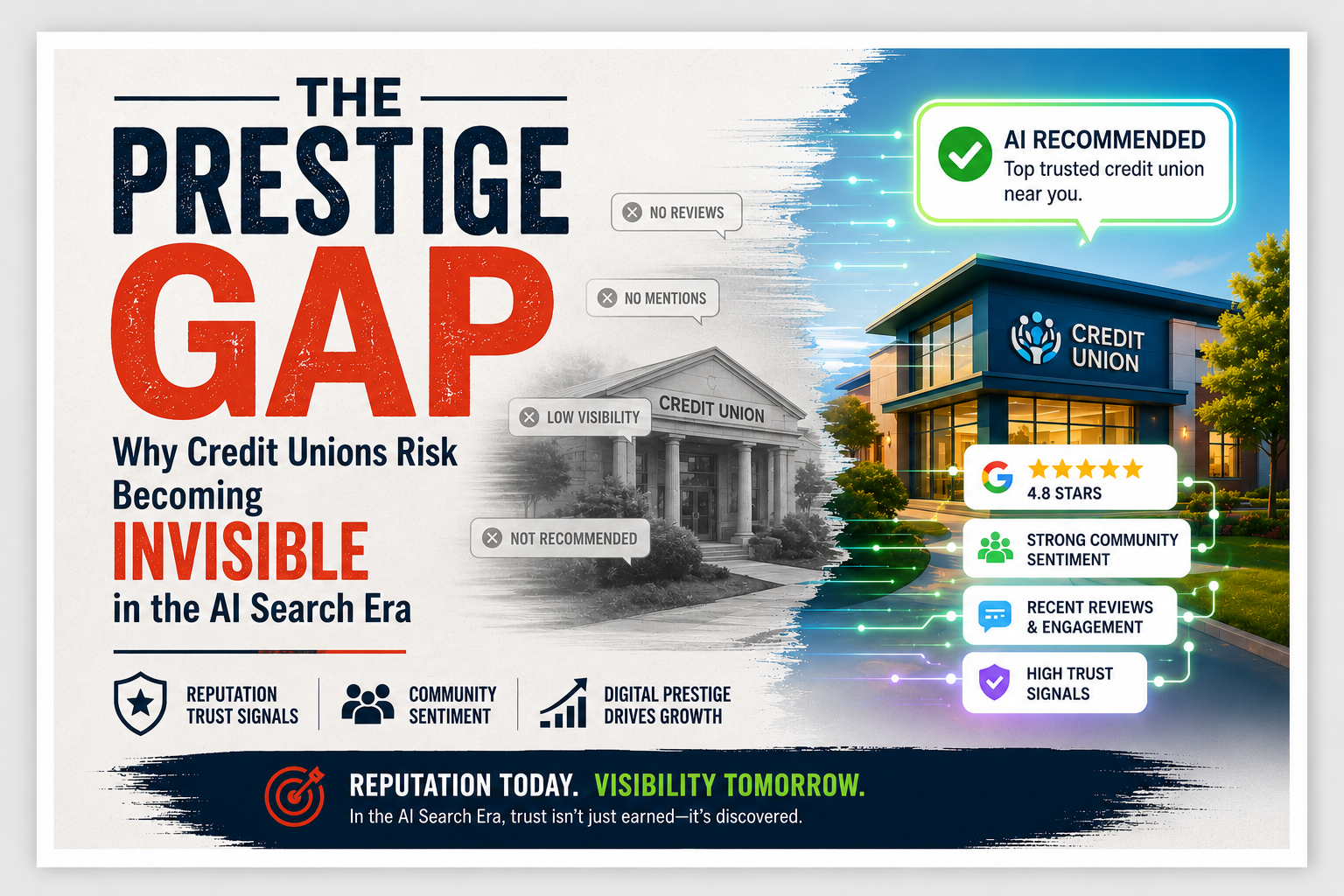
Executive Summary
The financial services industry is entering a new visibility crisis.
For decades, credit unions competed primarily on rates, service, branch access, and community relationships. Today, however, a new layer of competition has emerged — algorithmic trust.
Consumers are no longer relying solely on traditional search engines or advertising to choose financial institutions. Increasingly, they are asking AI-powered systems such as ChatGPT, Google Gemini, Perplexity AI, Siri, Alexa, and Google AI Overviews questions like:
- “What’s the best credit union near me?”
- “Who has the best auto loan experience?”
- “Which local financial institution is most trusted?”
- “What credit union has the best reputation?”
- “Who should I refinance my car with?”
The institutions AI systems recommend will capture disproportionate market share. The institutions AI systems ignore may effectively disappear from consideration entirely.¹

This shift represents one of the most significant competitive threats credit unions have faced in the digital era. AI search systems increasingly evaluate:
- Online review sentiment
- Review volume and recency
- Community reputation
- Employee reviews
- Brand mentions
- Digital authority
- Consistency of institutional data
- Community engagement
- Public trust indicators
As a result, reputation management is no longer simply a marketing concern. It is now directly tied to:
- Membership growth
- Deposit acquisition
- Loan generation
- Recruiting effectiveness
- Community authority
- AI visibility
- Long-term institutional relevance
Credit unions that fail to build visible digital trust ecosystems risk becoming increasingly invisible to younger consumers and AI-driven discovery systems.²
The Rise of AI-Driven Financial Discovery
AI-powered search platforms synthesize information from thousands of digital trust indicators to recommend institutions.
Unlike traditional search engines that display ranked lists, AI systems increasingly provide summarized recommendations or direct answers.
For example:
A user who searches: “Best auto loan lender near me” may receive only a handful of institution recommendations — or in some cases, a single recommendation. The implications are profound.
Institutions lacking strong public trust ecosystems may not appear at all. AI systems increasingly evaluate:
• Google Reviews
• Review recency
• Review consistency
• Community mentions
• Reddit discussions
• Social proof
• Employee sentiment
• Local authority
• Digital engagement
• Topical expertise
• Website trustworthiness
According to Vibrant Brands, financial institutions with stronger authority and trust ecosystems are increasingly favored by AI-powered search systems.⁵
This means institutional visibility is no longer determined solely by advertising budgets or search rankings. It is increasingly determined by perceived trustworthiness.
The Reputation Economy
The financial industry has entered what can best be described as a “prestige economy.”
In this environment, AI systems prioritize institutions demonstrating:
- Authority

- Credibility
- Consistency
- Community validation
- Expertise
- Public trust alignment
Historically, reputation management was viewed as:
- Public relations
- Branding
- Customer service support
- Social media management
Today, reputation directly impacts:
- Organic discovery
- AI recommendation frequency
- Membership acquisition
- Lending opportunities
- Deposit growth
- Recruiting performance
- Consumer trust conversion

Modern trust systems function as compounding assets.
Strong reputation signals reinforce:
- Search visibility
- AI recommendation likelihood
- Consumer confidence
- Referral activity
- Conversion rates
Weak reputation signals compound negatively.
Research from Yext notes that AI systems increasingly rely on publicly visible trust indicators to determine which organizations appear authoritative and credible.⁶
Why Traditional NPS Metrics Are No Longer Sufficient
For many credit unions, Net Promoter Score (NPS) has become a core measurement of organizational performance.
NPS remains valuable.
However, executives must recognize a critical distinction:
- NPS measures internal satisfaction.
- AI systems evaluate external trust visibility.
A strong NPS score may indicate existing members are satisfied, but prospective members never see internal survey data during discovery.
AI systems do not evaluate:
- Internal satisfaction surveys
- Confidential member polling
- Internal loyalty metrics
They evaluate public trust ecosystems.
This includes:
- Public review sentiment
- Online reputation
- Employee reviews
- Community discussion
- Public engagement
- Review recency
- Third-party validation
As a result, many institutions face what can be described as the “Invisible Excellence Problem.”
An institution may provide exceptional service internally while simultaneously appearing digitally irrelevant externally. This creates a dangerous disconnect.
A credit union can maintain:
- Strong member satisfaction
- Stable retention
- High internal loyalty
while steadily losing future relevance among younger consumers and AI-driven discovery systems.
According to The Financial Brand, institutions with weaker public reputation signals increasingly face visibility degradation across modern search ecosystems.⁷
Internal Trust vs. External Trust
Internal Trust Metrics
- Net Promoter Score (NPS)
- Member satisfaction
- Retention rates

- Complaint resolution
- Service experience
External Trust Metrics
- Google review ratings
- Review recency and velocity
- AI visibility
- Community sentiment
- Employee reputation
- Digital authority
- Public brand mentions
- Recommendation frequency
Both categories matter.
However, only external trust signals influence whether prospective members discover the institution in the first place.
This distinction is becoming strategically critical as AI-driven discovery increasingly replaces traditional search behavior.⁸
The Impact of Community Sentiment
Community sentiment increasingly acts as a digital proxy for institutional credibility.
AI systems evaluate public conversations surrounding institutions to determine:
- Relevance
- Trustworthiness

- Authority
- Community standing
This includes analysis of:
- Online reviews
- Social engagement
- Local media mentions
- Community discussions
- Public sentiment patterns
Silence itself has become a negative signal.
Institutions with limited public discussion may increasingly appear:
- Less relevant
- Less trusted
- Less authoritative
- Less active within their communities
Meanwhile, institutions with strong engagement and sentiment benefit from algorithmic reinforcement.
The institutions communities discuss most positively are increasingly the institutions AI systems recommend.
Research on digital trust and AI adoption consistently shows that users place growing confidence in algorithmic recommendations and public validation systems.⁹
Employee Reviews and Institutional Prestige
One of the most overlooked reputation variables is employee sentiment.
Modern consumers increasingly evaluate employer reputation as part of institutional credibility.
AI systems now factor in:
- Glassdoor reviews
- Indeed ratings
- Workplace culture sentiment
- Leadership perception
- Employee advocacy
This is especially important among younger demographics who increasingly align purchasing and banking decisions with perceived organizational culture and ethics.
Negative employee sentiment can impact: 
- Recruiting
- Retention
- Public trust
- AI visibility
- Institutional prestige
Consumers often interpret poor employee experiences as indicators of operational instability or cultural weakness.
In the AI era, workplace reputation is no longer internal.
It is publicly visible infrastructure.
InMoment notes that modern reputation management extends beyond customer reviews into overall institutional credibility and trust perception.¹⁰
Younger Consumers and the Trust Shift
Consumers under 40 increasingly rely on algorithmic validation before making financial decisions.
This demographic:
- Trusts peer reviews
- Uses AI assistants for recommendations
- Relies on social proof
- Evaluates employer reputation
- Expects digital credibility

Many younger consumers may never visit traditional search results at all. Instead, they increasingly interact directly with:
- AI chat systems
- Voice assistants
- AI-generated summaries
- Conversational search interfaces
If a financial institution is not recommended within these systems, it may never enter the consideration set.
This creates a major strategic risk for institutions relying on legacy reputation rather than visible digital authority.
Research published through arXiv highlights how trust strongly influences user reliance on AI systems and recommendations.¹¹
The Financial Impact of Reputation Signals
Research consistently demonstrates a strong relationship between reputation and revenue outcomes.
Improved trust signals influence: 
- Loan applications
- Deposit acquisition
- Mortgage inquiries
- Auto refinance opportunities
- Member retention
- Cross-sell conversion
- Organic growth efficiency
According to Harvard Business School research, even modest improvements in online ratings can materially impact consumer purchasing behavior and revenue outcomes.¹²
AI-driven recommendation systems may amplify these effects significantly because recommendation visibility becomes concentrated among a smaller set of institutions.
Unlike traditional search engines that displayed many results, AI systems frequently narrow recommendations dramatically.
This creates winner-take-most dynamics.
Institutions with stronger trust ecosystems will likely capture disproportionate market share.
Strategic Risks Facing Credit Unions
Credit unions that fail to actively manage digital prestige face increasing exposure to:
- Reduced AI visibility

- Lower organic discovery
- Higher acquisition costs
- Declining younger-member acquisition
- Reduced lending opportunities
- Weakening deposit growth
- Recruiting challenges
- Perceived institutional irrelevance
These effects may emerge gradually before becoming financially significant.
The greatest risk is that institutions may not recognize the visibility decline until future growth pipelines have already deteriorated.
Industry SEO and AI visibility research increasingly suggests that organizations with stronger digital authority ecosystems outperform competitors in AI-generated recommendation environments.¹³
Strategic Recommendations for Executive Leadership
1. Treat Reputation as Growth Infrastructure
Reputation management must become an executive-level operational priority rather than a
marketing initiative. Measure: 
- Review sentiment
- Review velocity
- Community engagement
- Employee reputation
- AI visibility
- Public trust signals
3. Invest in Local Authority and Content Expertise
Credit unions should establish visible expertise around:
- Auto lending
- First-time homebuyers
- Community financial education
- Small business banking
- Regional economic topics
Localized authority strengthens AI relevance.
According to Bytes.co, local topical authority increasingly influences AI-generated recommendations.¹⁴
 5. Optimize for AI Visibility
Institutions should ensure:
- Consistent institutional data
- Accurate local listings
- Strong website authority
- Structured content architecture
- Reputation monitoring
- AI-readable trust signals